
A broker says the practice is worth 70% of collections. The accountant says four and a half times EBITDA. A DSO says something else again. None of them has opened the practice software yet, and when they do, the number moves.
This page explains the three methods, works an EBITDA example you can copy, and lists what a buyer’s due diligence team actually pulls from Open Dental, Dentrix or Eaglesoft. We do not print multiples or percentages as benchmarks: they change with interest rates, region and buyer type, and any figure here would be stale within a year. Ask your broker or valuer for the source and date of theirs.
What are the three methods?
1. Multiple of collections. Annual collections multiplied by a percentage. Quick, common for small general practices sold dentist to dentist, and blind to profit. Two practices collecting $1.5 million with overheads of 55% and 75% get the same number under this method, which is why it is only a first guess.
2. Capitalisation of earnings, or multiple of EBITDA. Normalised profit multiplied by a factor that reflects risk and growth. This is what DSOs and lenders use.
3. Asset based. Equipment, supplies, receivables and leasehold improvements at fair value, plus goodwill. Used when earnings are weak or the practice is being closed rather than sold as a going concern.
A valuer usually runs all three and explains the gap.
How do you work out EBITDA?
Start from the last 12 months of collections and the tax return, then adjust. The usual mistake is to count the owner’s pay twice, so keep the owner’s draw out of operating expenses from the start.
| Line | Amount |
|---|---|
| Collections | $1,620,000 |
| Operating expenses, excluding owner pay, depreciation and interest | $669,000 |
| Market salary for the owner’s clinical work | $290,000 |
| Add back one-off items (a legal dispute, a flood) | +$18,000 |
| Add back owner’s personal expenses run through the practice | +$12,000 |
| Normalised EBITDA | $691,000 |
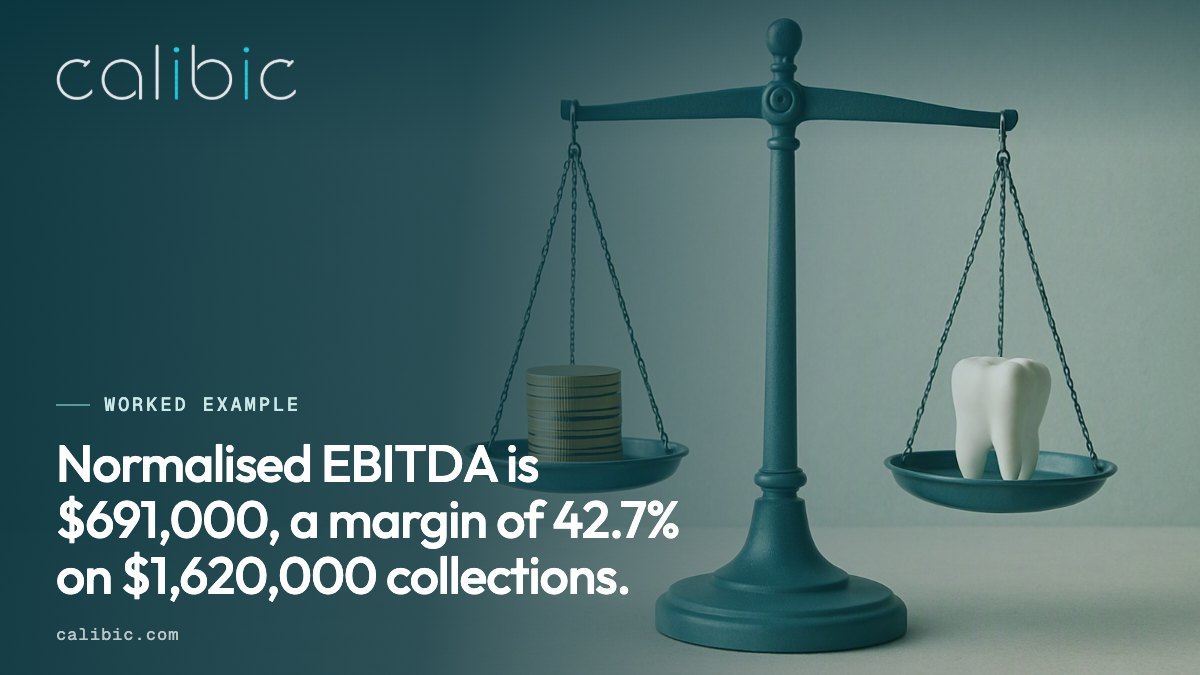
Check it: $1,620,000 minus $669,000 = $951,000. Minus $290,000 = $661,000. Plus $18,000 plus $12,000 = $691,000. EBITDA margin = $691,000 divided by $1,620,000 = 42.7%.
The owner’s actual draw ($310,000 in this example) does not appear. What appears instead is what a buyer would have to pay a dentist to do the same clinical work. Depreciation and interest are left out because the buyer’s equipment and financing will differ. Every add-back needs its own line, because a buyer will rebuild the table from the general ledger and remove any they cannot trace.
What do buyers check in the practice software?
A letter of intent is followed by a data request. Expect these, pulled by the buyer’s team, not by you:
- Active patient count, defined as seen in the last 18 or 24 months, with the definition stated. Patients with no visit in three years are not counted.
- New patients per month for 24 months, from the first-visit date.
- Recall rate and hygiene pre-booking. A practice whose hygiene schedule is full six weeks out is worth more than one that is not. The recall benchmark page shows the formula.
- Production by provider. How much depends on the selling dentist personally.
- Payer mix. Share of production by fee-for-service, PPO, HMO and Medicaid, with the contractual adjustment rate for each.
- Net collection rate and AR aging. The net collection rate page covers the formula.
- Unscheduled treatment. Planned and not booked. Buyers see it as upside; sellers should see it as money to recover before the sale.
- Adjustments by type and user. Unexplained courtesy adjustments lower the offer.
- Audit trail integrity. Whether the security log has been running and whether users share log-ins.
Why does clean data raise the price?
Because a buyer discounts for uncertainty. If active patients cannot be counted without an argument about the definition, the buyer uses the lower number. If adjustments are a single type called “Adjustment”, the buyer assumes some of them hide collection problems. If the audit log is off, the buyer prices in the risk.
Twelve months before a sale, the cheapest improvements are: fix recall dates and inactivate dead charts, split adjustment types, chase claims over 30 days, and work the unscheduled list. Each one moves a line in the buyer’s spreadsheet.

What Calibic adds
The KPI dashboards and reports are LIVE. Calibic reads Open Dental, Dentrix and Eaglesoft read-only (it never changes a record) and produces the operational numbers above (active patients with the definition shown, production by provider, payer mix, net collection rate, AR aging, unscheduled treatment, adjustments by type and user) with every figure opening to its rows, so the data request is answered from the same screens you already use. Calibic does not value practices and does not produce EBITDA; that comes from your accountant and the general ledger. The dental KPIs page is the operating view of the same numbers.
Next step: the overhead calculator is where the expense side of the EBITDA table starts.